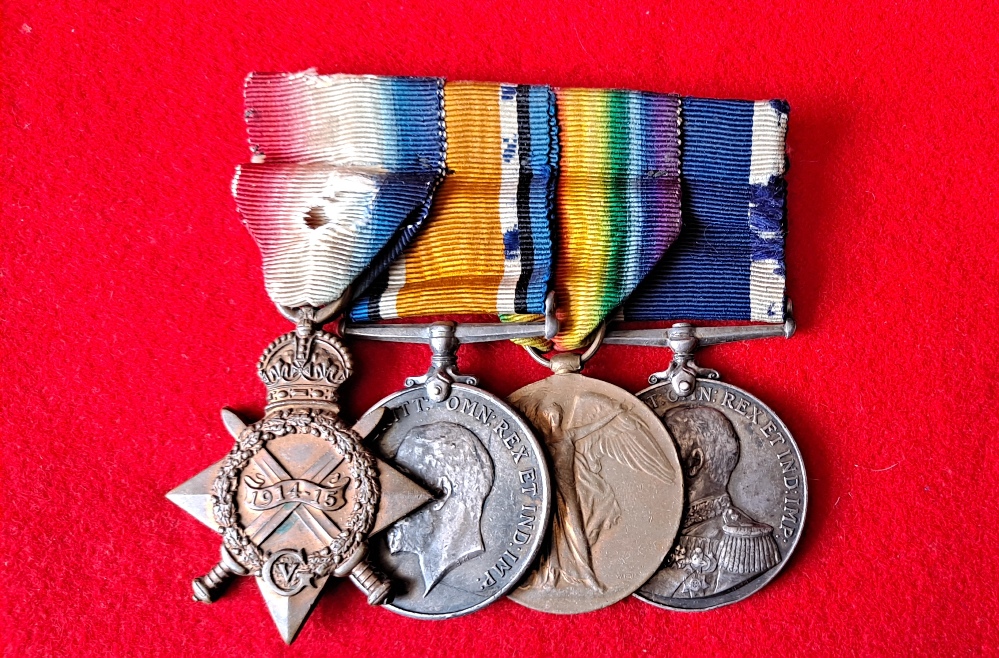
Description A scarce 1914 Star medal group to a mechanic serving in Samson’s Armoured Cars, Royal Naval Air Service. F98 Frederick Henry Jackson served with Number 1 Squadron, Number 3 Squadron and served at Dunkirk Air Stations. All 3 of these postings entitling him to the 1914 Clasp as confirmed on the medal roll and list S.R. 358. His service papers further confirm that he was awarded to 1914 Star in February 1919. 1914 Clasp Qualifying sectors Jackson’s 3 x 1914 Clasp Qualifying sectors medals, swing mounted as worn – 1914 star with clasp ( F98. F. H. JACKSON. A.M. R.N.A.S. ), British War Medal and Victory Medal ( F98. F. H. JACKSON. L.M. R.N.A.S. ). The 1914 Star also has 2 rosettes sewn in, these are believed to represent, along with the clasp, the 3 postings with which he qualified for the the clasp, see roll annotation. Frederick Henry Jackson was born 24th March 1891 in Hemel Hempstead, Hertfordshire. He was a motor fitter by trade when he joined the service on the 19th August 1914 for the period of hostilities. He had previously served, briefly, as a bugler with the Hertfordshire Volunteers. Naval Party engagements In 1914 the Royal Navy separated the Naval Wing from the Royal Flying Corps, naming it the Royal Naval Air Service (RNAS). In July Samson was appointed Officer Commanding the Eastchurch (Mobile) Squadron which was renamed No. 3 Squadron RNAS by September. When the First World War broke out, Samson took the Eastchurch RNAS Squadron to France, where it supported Allied ground forces along the French and Belgian frontiers. In the late summer of 1914, with too few aircraft at his disposal, Samson instead had his men patrol the French and Belgian countryside in the privately owned cars some of them had taken to war. The first patrol comprised two cars, nine men, and one machine gun. Inspired by the success of the Belgians’ experience of armoured cars, Samson had two RNAS cars, a Mercedes and a Rolls-Royce, armoured. These vehicles had only partial protection, with a single machine gun firing backwards, and were the first British armoured vehicles to see action. Within a month most of Samson’s cars had been armed and some armoured. These were joined by further cars which had been armoured in Britain with hardened steel plates at Royal Navy workshops. The force was also equipped with some trucks which had been armoured and equipped with loopholes so that the Royal Marines carried in them could fire their rifles in safety. This was the start of the RNAS Armoured Car Section. Aggressive patrolling by Samson’s improvised force in the area between Dunkirk and Antwerp did much to prevent German cavalry divisions from carrying out effective reconnaissance, and with the help of Belgian Post Office employees who used the intact telephone system to report German movements, he was able to probe deeply into German-occupied territory. Closer to Dunkirk, Samson’s force assisted Allied units in contact with the Germans, and at other times made use of their mobility and machine guns to exploit open flanks, cover retreats, and race German forces to important areas. Please contact us to agree delivery system and cost. Overseas buyers must contact us prior to ordering. Pricing is ex store. All shipping, import and export duty and other taxes will be paid by the buyer.