$20.51
$26.05
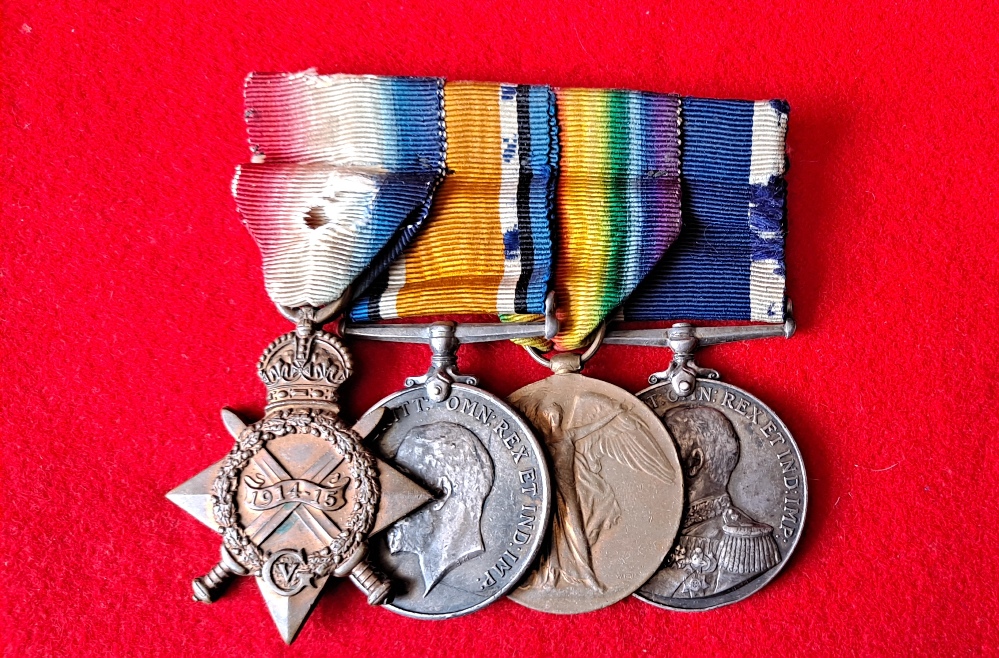
Description The rare opportunity to buy the Great War medal trio of a 1908 Olympics Gold Medal winner. Reggie Walker won the 100 metres Gold Medal at the 1908 Olympics held in London. Less than 10 years after his Gold Medal feat he served in the South African Infantry and was wounded in France. During World War I Walker served with the 7th Infantry in German South West Africa, before joining the South African Overseas Expeditionary Force in 1917, serving in France, during which time he received a gunshot wound to the head. He is also recorded as having suffered from disease during the war. The Great War medal group of three awarded to Lance-Corporal R. E. Walker, 7th South African Infantry, who won the Gold Medal in the 100 metres at the 1908 London Olympic Games, and in the same year set a new world record for the 100 yards in a time of 9.4 seconds; at the age of just 19 he is the youngest ever winner of the 100 metres at the Olympics, and was the first South African athlete to win an Olympic Gold Medal Medals – 1914-15 Star (Pte. R. E. Walker 7th Infantry); British War and Bilingual Victory Medals (L/Cpl. R. E. Walker, 4th S.A.I.). His later attestation papers confirm that 11798 Reggie Walker was 28 years old when he attested into the South African Infantry on the 14th February 1917 at Potchefstroom for the duration of the war and is noted as a Clerk and Athlete. He had previously served in the Kimberley Regiment and the Railway Pay Staff. His first period of service was in 1914 in German South West Africa (Duitwes). These papers state that he was discharged in the UK surplus to requirement having suffered impairement. His disability noted a Gunshot wound to the head, trench foot and boils. He married Maisie Minnie Hill, a Londoner born 1893, in 1917. Maisie had been one of his nurses whilst he was hospitalised with measles. They married on St Johns, Woking, Surrey. He later married Sarah Ann Lynch at Salford Register Office in 1926. Reginald Edgar Walker was born in Durban, South Africa, on 16 March 1889. A distinguished athlete, he won the 220 yards sprint at the 1907 South African Championships, and the following year travelled to England to compete at the 1908 London Olympics. Entering the ‘blue riband’ event of the Games, the men’s 100 metres sprint, he won the gold medal in the final, held on 22 July 1908, equalling the Olympic record time of 10.8 seconds. At the age of 19 years and 128 days, he is the youngest ever winner of the 100 metres at the Olympics, and was the first South African athlete to win an Olympic Gold Medal. Walker had further success that summer, and at Abergavenny on 4 August 1908 he set a new world record for the 100 yards in a time of 9.4 seconds (equivalent to a time of 10.3 seconds for the 100 metres). Remaining in England, the following year he won the British Amateur Athletics Association 100 yards title, before turning professional in 1910 (which made him ineligible to defend his Olympic title in the 1912 Stockholm Olympics). The medal trio came with an Abergavenny Amateur Athletics Association Certificate recording Walker’s World Record run on 4 August 1908, and signed by various officials, mounted together with a photograph of both the recipient and the watch used to record his record run. 1908 Olympics. Reggie Walker 100 metres Gold Medal at the 1908 Olympics Reggie Walker, the 1907 South African Champion, was not among the big favourites for the 100 metres at the 1908 Summer Olympics. He even had trouble getting to London as he lacked the necessary finances until a Natal sportswriter collected funds to support Walker’s travel. In England, he was coached by Sam Mussabini, later also the coach of Harold Abrahams (Chariots of Fire). Several of the big names did not qualify for the final, but Walker did. His first round was a relatively easy victory run in 11.0 seconds. In the second round, Walker edged out William W. May of the United States while tying the Olympic record of 10.8 seconds. This qualified him for the final. There he competed against three North Americans, including James Rector of the United States, who had equalled the Olympic record in both of the qualifier rounds. Walker beat Rector in the final by about a foot and half, again equalling the Olympic record in 10.8 seconds. Olympics 1908 Gold Medal Walker was still the youngest winner of the Olympic 100 metres as of 2021 (at 19 years and 128 days). “The First World War had a major effect on the soldiers on both sides of the conflict, including those colonials who joined up with the ‘Mother Country’, and Walker himself was never the same again as a runner despite being still a young man when the War ended. His performance, or lack of performance, as a professional, may have been the result of injuries, illness and the War,” (ack. Pitchford) Walker was discharged from the Army in 1919 and later worked as a clerk with Ropes & Mattings in Nairobi, Kenya Colony, before returning to South Africa. He died in Durban on 5 November 1951, aged 62. The following text is the epilogue of the work “Reggie Walker – The Natalian Sprinter” – a thesis by Deborah Marie Pitchford. This biographical work is a superbly detailed delve into the life and world of Reginald Walker. At a personal level, Walker, the ‘little Natalian’, fell into disfavour with both the South African and the British athletic authorities after he turned professional. Reggie’s colonial victory at the 1908 London Games was his highest achievement as an amateur although, during his athletic career, he established several world records, the majority achieved in South Africa. As a professional, he defeated the American Charles Holway five times during his career, although he was not as successful against Arthur Postle, often portrayed as Walker’s main rival in the media. Unfortunately for Reggie his transition into the professional ranks came at a bad time. The First World War had a major effect on the soldiers on both sides of the conflict, including those colonials who joined up with the ‘Mother Country’, and Walker himself was never the same again as a runner despite being still a young man when the War ended. His performance, or lack of performance, as a professional, may have been the result of injuries, illness and the War, but it also appears that Reggie was perhaps never fully committed to running as a professional because he did not follow through on any of his intentions to visit the major professional circuits in either Australia or America. However, he did leave a legacy in the form of his athletic manual, which was reproduced three times after his disappearance from the athletic circuit. In addition, while Walker, a colonial born in South Africa, later became a difficult man with a drinking problem, his early athletic career had reflected great credit on himself and that of his native land, while also exhibiting the traditional values of British sport and visions of acceptable masculinity. Reggie left his legacy in the form of his manual – Text Book of Sprinting by R E Walker hardback circa 1910, an original copy of which is included in this lot. A finer First World War medal trio to a world class, world beating athlete will be hard to find. This will be a interesting group to research and write up in both Olympics and Athletics history and in his military capacity in the South African Infantry during the Great War. Overseas buyers must contact us to agree shipping prior to order. Email [email protected] for details or call Jonathan Godwin (see image) This sprinter clocked 10.6 seconds 100m 1978 is the proud, currentowner of the Reggie Walker WW1 medals on 07765 595662 to arrange. Reggie Walker Death Notice The greatest runner of his day The Victor Held Aloft Olympics 1908 Gold Medal On the obverse, two female figures placing a laurel crown on the head of a young victorious athlete, with, in the bottom half, the inscription: “OLYMPIC GAMES LONDON 1908″. On the reverse, the figure of St. George, patron saint of England. Legend says that he was a fighting saint who slew a dragon to free a princess. Designer: Bertram Mackennal Composition: 1st Place (Gold), 2nd Place (Silver), 3rd Place (Bronze) Diameter: 33mm Mint: Vaughton & Sons Overseas buyers are required to contact us prior to payment. Our pricing is ex stock.
Ww1 Medal Groups